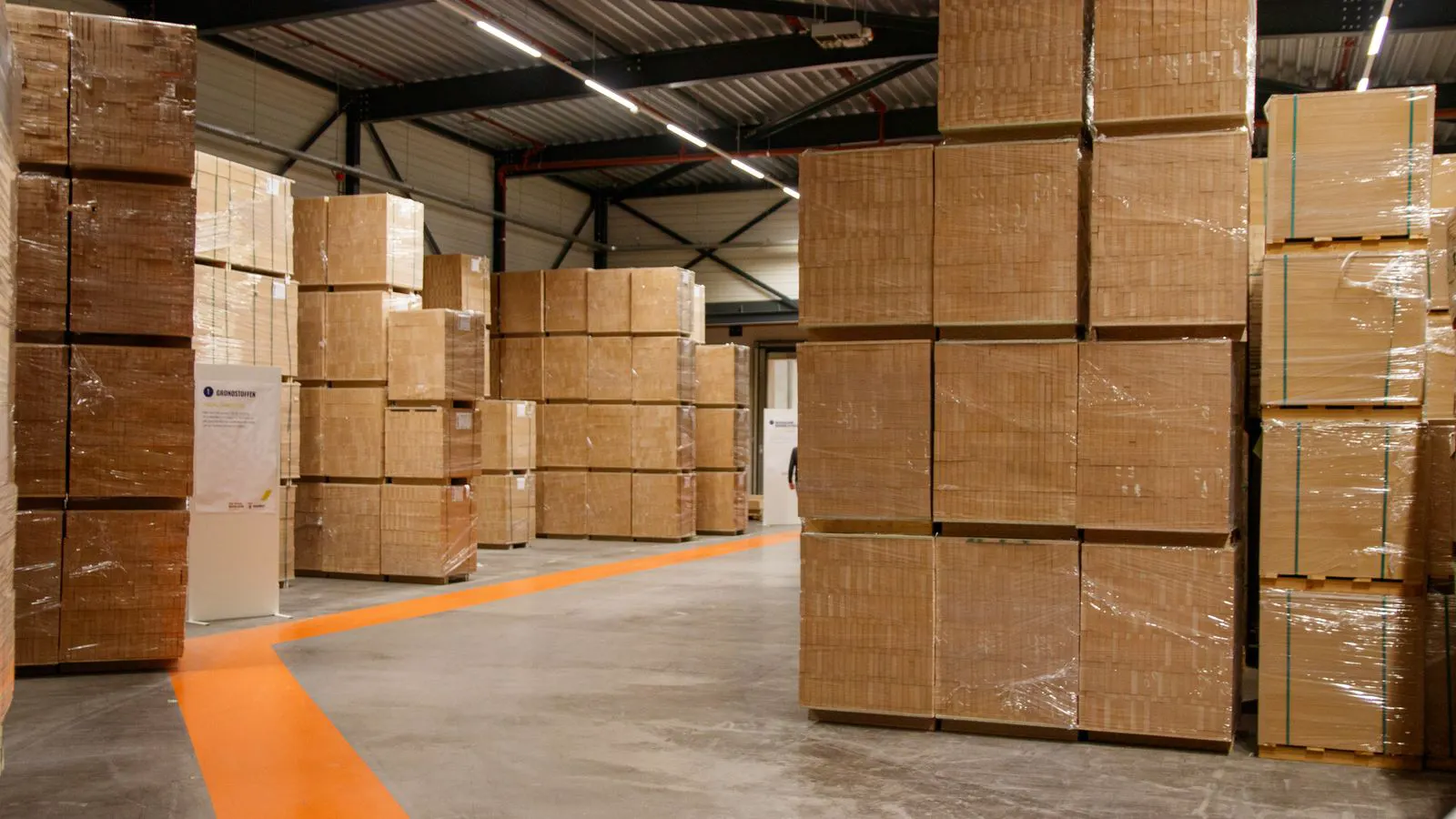
Flute type changes stacking performance by altering the number of walls per unit length. A double flute increases compressive strength but adds weight and cost. This structural design choice directly affects sourcing decisions and box testing results.
- Flute geometry sets the baseline for a box's vertical compression strength.
- Double flutes add more wall area, increasing stacking load capacity.
- Thicker single flutes weigh more and cost more than double flutes of the same EBC.
- Match flute type to stacking height and internal load, not just single-box strength.
- Verify flute performance with compression tests before finalizing packaging design.
What the flute actually does
The corrugated flute is the wave-shaped layer between the two liner sheets. When you press down on a box, the flute walls bend. They do not just act as filler. They convert vertical force into bending stress across the corrugated structure. The walls are not straight vertical struts. They are angled surfaces that share the load across a larger area of the liner.
The number of flutes per inch of board width determines how much resistance the board has. A board with a shorter, tighter flute has fewer walls in a given area. A board with a longer, gentler flute has more walls. That difference is not cosmetic. It changes the whole structural design of the case.
Consider a standard single flute board. In a one-inch width, you might see three or four peaks and valleys. Now look at a micro flute board. In that same inch, you might see twenty or more tiny peaks. The micro flute has far more wall surface area. It does not offer the same deep bending resistance as a tall flute, but it provides excellent surface rigidity. It stops the liner from buckling locally. It also improves the appearance of the outer face for printed graphics.
The flute geometry creates a channel. When the box is under load, air pressure inside and outside the box remains equal, so the structure relies on material stiffness. If the flute walls are thin, they collapse easily. If they are thick and tall, they resist bending. The angle of the walls matters too. Steeper walls offer more vertical projection per unit of flute height, which increases the effective column length. Gentle walls spread the load over a wider footprint but reduce the effective height.
How flute height changes compression strength
Flute height is the distance from the bottom of a wave to the top of the next wave. A taller flute gives each wall more length to resist bending. Under vertical load, the walls act like small columns. A taller column bends less than a shorter one of the same material, assuming the liner is the same. This is the fundamental principle of column stability.
This is why heavier goods often sit in taller-flute boxes. The structure has more capacity before the flutes crush and the box collapses under its own weight. The liner sheets carry some load too, but the flute walls do most of the vertical compression work.
Think of the flute walls as a grid. When you apply pressure, the grid compresses. The walls buckle inward. The amount of compression before failure is the edge crush strength. A taller flute has more material to buckle. It takes more force to crush that material. A shorter flute has less material. It crushes sooner.
There is a limit to this benefit. If the flute is too tall, it becomes unstable. The walls are long and thin. They may buckle sideways before they buckle vertically. The liner sheets must be stiff enough to keep the walls aligned. If the liner is too soft, a very tall flute will not perform as well as a shorter flute. The liner and the flute must work together.
Single versus double flute
Single flute means one row of corrugations between the liners. Double flute means two. The second row roughly doubles the amount of corrugated wall in the same footprint. The structure becomes significantly stiffer. The box gains a lot of vertical strength without adding much to the overall thickness.
The trade-off is weight. Double flute board is heavier than single flute board of the same basis weight class. Heavier board means more material to ship and more cost per case. It also changes the structural design of the box. A double-flute box can be thinner if you need the same strength, or it can be the same thickness with more reserve strength.
In practice, double flute is common for boxes that hold heavy, dense products. Think of a box for tools, electronics, or food cans. These items are heavy. The box sits in a stack. The bottom box takes the weight of the boxes above it. Double flute gives that bottom box the capacity to hold.
Triple flute adds a third row. It is less common. It is used in extreme stacking applications, such as industrial pallets that sit on the bottom shelf of a warehouse for months. The box must support tons of weight. Triple flute provides the wall area needed for that load.
Micro flute is different. It uses many short flutes. It is not for heavy vertical loads. It is for surface protection. It stops the liner from denting. It improves the look of the printed side. It is lighter than standard flutes. It is often used for retail packaging where the product is light and the box is not stacked high.
How this affects sourcing decisions
When you specify a box for a tall stack, flute type is a sourcing decision, not just a manufacturing detail. The supplier will quote based on the flute profile and the liner grade. Changing from a single flute to a double flute changes the price, the weight, and the compression test results.
Buyers should state the stacking height in the design brief. If the box will sit under four pallets in a distribution center, the structural design must support that load. A single-flute box might fail at the third layer. A double-flute box might hold. The difference is not about strength in a vacuum. It is about how many layers the box must survive.
The sourcing decision also affects inventory. A double-flute board is heavier. It takes up more space in the warehouse. It costs more to transport. If you switch from single to double flute, your total cost per case increases. You must weigh that increase against the cost of damaged goods or failed shipments.
Also consider the pallet. If the pallet itself is heavy, the load on the bottom box increases. If the pallet is light, the box carries more of the weight. The design brief must include the pallet weight. The compression test must simulate the actual conditions.
Box testing and validation
Box testing confirms that the structural design works. A compression test applies load to the closed box and measures the force at which it fails. The result is the maximum load the box can carry before deformation becomes permanent. The test is usually done on a closed, filled box. The product inside is replaced with a weight that matches the actual product weight.
When comparing flute types, test the same box geometry with different board constructions. Keep the liner grade and thickness constant. Change only the flute. The test isolates the effect of the flute geometry. This is the cleanest way to see how flute type affects vertical compression strength.
The test machine applies force evenly across the top of the box. The machine measures the force in newtons or pounds. It records the point where the box fails. The result is the compression strength. You compare that number to your target stacking load.
If the compression strength is higher than the target load, the box has reserve strength. That is good. Reserve strength protects the box during rough handling. If a forklift shifts the pallet, or a worker drops a box, the box can absorb the shock without failing.
If the compression strength is lower than the target load, the box will fail in the stack. You must change the design. You can increase the flute height, change the flute type, or upgrade the liner.
A worked example
Imagine a box that will hold one hundred kilograms of product. The product will be stacked five high in a warehouse. The box must support its own weight plus the weight of the boxes above it.
First, calculate the stacking load. Each box holds one hundred kilograms. The bottom box in a five-high stack supports four boxes above it plus its own contents. That is a load of five hundred kilograms from the boxes above, plus the product weight of the bottom box itself. The total load on the bottom box is roughly five hundred kilograms, plus the box weight.
Now choose the flute. A single-flute box of standard construction might handle that load with little reserve. A double-flute box of the same thickness handles the same load with more reserve. The double-flute box has more wall area. It fails at a higher force.
The structural design decision is to specify double flute for this application. The cost is higher. The weight is higher. But the box survives the five-high stack without visible damage. That reserve strength protects the product during handling.
If you used single flute, the box might pass the compression test for a single box. But it would fail in the five-high stack. The bottom box would crush. The product inside might break. The cost of that failure is much higher than the extra cost of double flute.
Choosing the right flute for your stack
The right flute depends on three inputs: stacking height, product weight, and liner grade. A tall stack with light product may work with single flute. A short stack with heavy product may need double flute. The liner grade changes the math. A heavier liner adds strength without adding flute walls.
Do not guess. Run the compression test. The test result tells you how many layers the box will survive. If the result is below your target stacking height, change the flute or the liner. That is the structural design loop.
The liner grade is often the first lever to pull. If the box is too light, increase the liner weight. If the box is too heavy, decrease the liner weight and increase the flute. The goal is to find the balance that gives you the required strength at the lowest cost.
Consider the environment. If the box will be exposed to moisture, the liner must be strong enough to handle the weight when the board is wet. Water weakens the corrugated board. The compression strength drops. The design must account for that drop.
Common mistakes in structural design
The most common mistake is specifying flute type based on single-box strength alone. A box can be strong on its own and still fail in a stack. Stacking is a different load case. The box must support the weight above it, not just its own contents.
Another mistake is ignoring liner weight. A heavy liner can compensate for a lighter flute. A light liner needs a heavier flute. The structural design is a balance between the two. Change one and the other must move.
A third mistake is not testing the final box. Board suppliers change their construction. A box that passed last year may fail this year. Re-test when the board changes, the dimensions change, or the stacking height changes. The specification must be locked, but it must be verified regularly.
| Flute Type | Wall Count | Typical Use | Weight Impact |
|---|---|---|---|
| Single | One row | Light product, low stacks | Lower |
| Double | Two rows | Heavy product, tall stacks | Higher |
| Triple | Three rows | Extreme stacking, industrial use | Highest |
| Micro | Many short | Surface protection, light loads | Low |
| Hybrid | Mixed | Custom strength, cost balance | Variable |
- State the maximum stacking height in the design brief.
- List the product weight and the expected pallet configuration.
- Select a liner grade that matches the load.
- Choose a flute type that gives the box enough compression reserve.
- Run a compression test on a sample box.
- Adjust the flute or liner if the test result is below target.
- Lock the specification and re-test after any material change.
Frequently asked questions
Why does double flute stack better than single flute?
Double flute adds a second row of corrugated walls. More walls resist bending under vertical load, so the box carries more compression before failing.
Can a heavy liner replace a double flute?
Sometimes. A heavier liner adds stiffness and crush resistance. But it adds weight and cost. A double flute of moderate weight may be lighter and cheaper than a very heavy single flute liner.
What is the fastest way to check stacking capacity?
Run a compression test on a finished box. Apply vertical load until the box fails. The force at failure is the maximum stacking load.
Does flute type matter if the box is not stacked?
Yes, but less. Flute type still affects the box's ability to hold its shape and protect contents from lateral pressure. For single-layer use, surface protection may matter more than vertical compression.
How does product weight change the flute choice?
Heavier product increases the load on each box. A heavier product usually requires a higher-flute or heavier-liner construction to keep the stacking reserve intact.